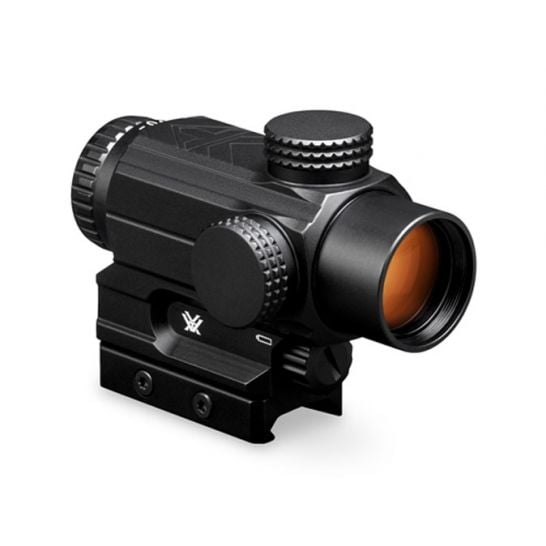
This AR-15 optics guide will help you choose between a red dot, LPVO, or prism scope depending on your intended purpose.
⸻
1. Red Dot Sights
Red dots are the most common optic choice for AR-15 rifles.
What They Are
A red dot sight projects an illuminated aiming point (usually a 2–3 MOA dot) onto a glass lens. There is no magnification.
Pros
• Extremely fast target acquisition
• Lightweight
• Simple to use
• Excellent for close-range shooting
• Great for home defense
Cons
• No magnification
• Less precise at longer distances (200+ yards)
Best For
• Home defense
• Tactical training
• Range use under 200 yards
• Lightweight builds
If your AR-15 has a 16” barrel and mid-length gas system, a red dot is often the most practical choice.
⸻
2. LPVO (Low Power Variable Optic)
LPVOs typically range from 1-4x, 1-6x, 1-8x, or even 1-10x magnification.
What They Are
An LPVO allows you to dial between true 1x (similar to a red dot) and magnified settings for longer shots.
Pros
• Extremely versatile
• Great for 100–500 yard shooting
• Better target identification
• Ideal for competition or hunting
Cons
• Heavier than red dots
• More expensive
• Requires proper mounting and eye relief
Best For
• 18” or 20” barrel builds
• Hunting
• Precision-focused rifles
• Multi-purpose rifles
If you’re running an 18” rifle-length gas system, an LPVO is often the ideal pairing.
⸻
3. Prism Scopes
Prism optics use an etched reticle rather than a projected dot.
What They Are
Unlike red dots, prism scopes have a fixed magnification (often 1x, 3x, or 5x) and an etched reticle that works even if the battery dies.
Pros
• Crisp reticle
• Works without battery power
• Good for shooters with astigmatism
• Compact compared to LPVO
Cons
• Fixed magnification
• Less flexible than LPVO
Best For
• Shooters with astigmatism
• Mid-range shooting
• Lightweight precision setups
⸻
Mounting Considerations
No matter which optic you choose:
• Use a quality mount
• Consider absolute vs lower 1/3 co-witness height
• Ensure proper eye relief (especially for LPVO)
Optics and rail systems work together. If you’re running M-LOK or Picatinny rails, make sure your mount is compatible.
⸻
What Should You Choose?
Choose a Red Dot if:
• You primarily shoot under 200 yards
• You want lightweight and simple
• Your rifle is for home defense
Choose an LPVO if:
• You want versatility
• You shoot 200–500 yards
• You’re building a precision or hunting rifle
Choose a Prism if:
• You have astigmatism
• You want a fixed magnified optic
• You want battery-independent reliability
⸻
Final Thoughts
The “best” optic depends entirely on your rifle setup and intended use. A 16” mid-length AR often pairs perfectly with a red dot. An 18” rifle-length build may benefit from an LPVO. Your optic should complement your barrel length, gas system, and overall purpose.
If you’re still deciding on your rifle configuration, check out our AR-15 Buyer’s Guide for a complete breakdown of components that matter.
Not Sure Which AR-15 Setup Is Right for You?
For a complete breakdown of barrel lengths, twist rates, and rail options, read our full guide:
The Ultimate AR-15 Buyer’s Guide (2026): What You Need to Know Before You Buy
Leave a Reply
You must be logged in to post a comment.